|
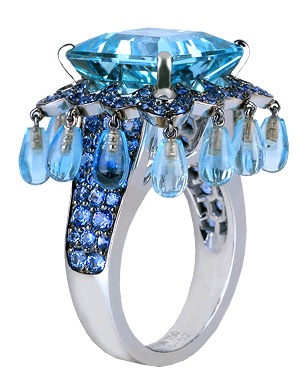
| Via Yale Jewelers |
Not bad for crystallized carbon, eh? You know, carbon- the same stuff we burn as fuel.
 |
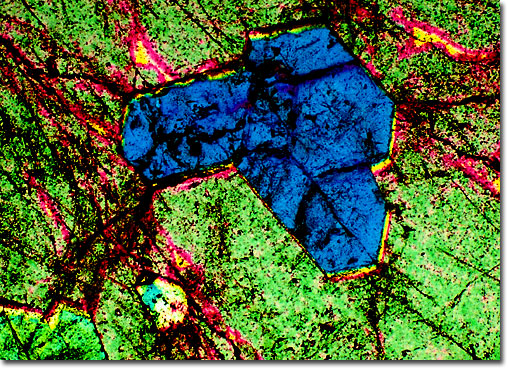
| Via Clean Technica |
OK, that's only technically true so I'll clear up the little myth that coal becomes diamonds. I live in a coal-producing region, so trust me, I checked this out because how cool would it be to till up a big honkin' diamond while working in the garden?
Coal will naturally convert to graphite but graphite will generally not, on its own, become diamonds. Yes, they are both carbon-rich but the internal structure, the way the atoms stack and align, is different. But, to make it more confusing for us, graphite not coal is used to create artificial diamonds. Simply apply insane amounts of heat and pressure and wah-la! fake diamonds. The funny thing is, no one is really certain just exactly how diamonds are formed, though they are generally formed more than 93 miles below the surface of the earth. Heat, pressure, time, and some sparkly magical science. Volcanic and plate tectonic activity brings the diamonds to the surface through structures known as kimberlite pipes. Hang with me.
Coal will naturally convert to graphite but graphite will generally not, on its own, become diamonds. Yes, they are both carbon-rich but the internal structure, the way the atoms stack and align, is different. But, to make it more confusing for us, graphite not coal is used to create artificial diamonds. Simply apply insane amounts of heat and pressure and wah-la! fake diamonds. The funny thing is, no one is really certain just exactly how diamonds are formed, though they are generally formed more than 93 miles below the surface of the earth. Heat, pressure, time, and some sparkly magical science. Volcanic and plate tectonic activity brings the diamonds to the surface through structures known as kimberlite pipes. Hang with me.
 |
| Image via mdiamonds |
Once the diamonds are formed, volcanic activity brings them to the surface in this kimberlite rock and the diamonds are deposited in volcanic-rock or wash out in rivers. Open pit diamond mines are associated with kimberlite pipes. The largest open pit mine in the world is the Mirny Mine in Eastern Serbia. The hole is so big that at one point the airspace above the mine was closed to helicopters as there were several incidents of them being sucked in by the downward air flow. This mine closed in 2001.
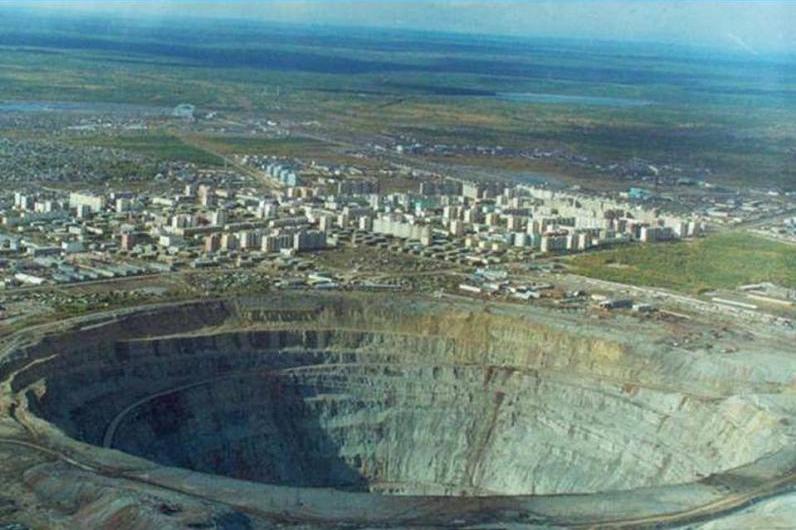 |
| Image via TwistedSifter |
That just freaks me out.
Diamonds get their name from the Greek word adamas meaning "unbreakable", "proper", or "unalterable". If someone says you are a gem of a friend, strive to be a diamond of a friend. Diamonds have been known to and used by humans since ancient times, the very earilest references coming out of India where they were documented as being the first river-sourced diamonds. The Hope Diamond came from India, along with 12 million additional carats of diamonds over the past 2,000 years. Not to be out-done, discoveries in Brazil and Russia soon outpaced Indian production. Then, in 1868, a young man in South Africa found a pretty stone near the Orange River. He asked Shalk Van Neikirk, a nearby farmer, if he would buy the stone. Van Neikirk immediately offered him every head of livestock on his farm: 500 sheep, 10 cows, and a horse. With the discovery of that 83.5 carat diamond (later named the Star of South Africa), Africa became the diamond-producing capital of the world.
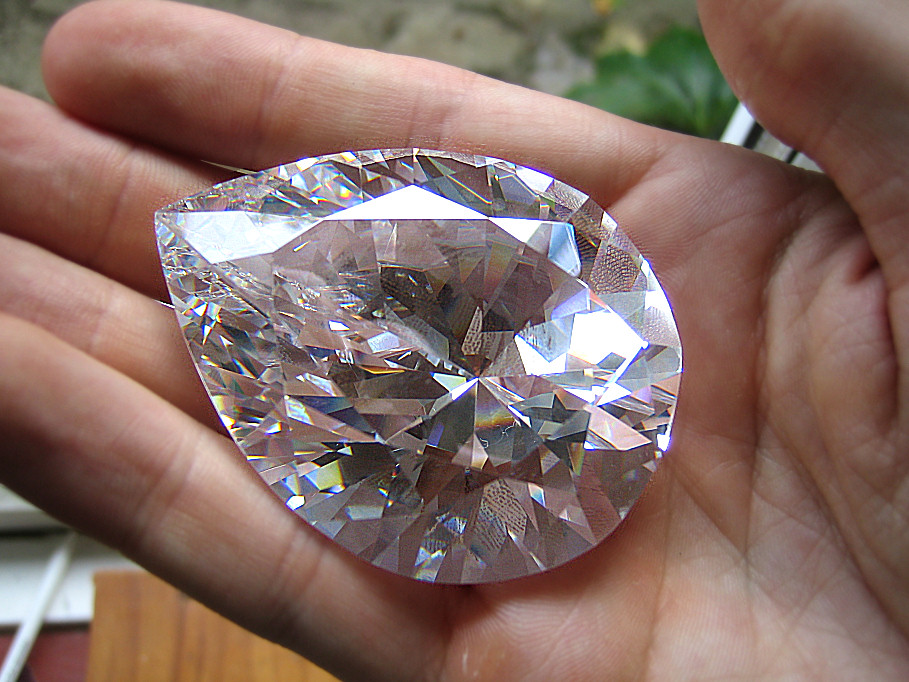 |
| Star of South Africa. Image via DiamondCZ |
The physical properties and beauty of diamonds have contributed to a vast collection of lore. Securing a diamond to your left arm is said to give victory in battle no matter how great your enemies may number. Ancient Greeks believed diamonds were the tears of gods while other cultures thought that diamonds were formed when lightening bolts struck the earth. Those are actually called fulgarites but that's another subject. Held in the right hand, diamonds were said to cure mania. Diamonds were believed to impart strength and courage. Considered the "universal amplifier", diamonds have long been strongly associated with love.
 |
| Image via Lang Antiques Sorry, it's sold. |
So- are diamonds the hardest substance on earth? Well, it's complicated, sort of. Of course. Diamonds are the hardest naturally occuring material but "hardness" simply refers to its resistance to being scratched. This does not refer to its density, tensile strength (amount of force required to tear it apart or the maximum load it can bear), or torsional strength (ability to withstand being twisted). A building made of diamond beams would not be very strong. Gorgeous, but not strong. Diamonds have a crystalline structure, which means they have an orderly, repeating pattern. Because of this structure, diamonds will fracture along these crystalline planes. Unlucky for the building contractor, lucky for the jeweler and some deserving female- and aren't we all deserving? Anyway, it is the diamond's hardness that gives it an "Excellent" rating with regards to wearability. Take care though, because if you whack your diamond on the edge of a counter or other hard object, it may do what it does that makes it so pretty- fracture.


Can you imagine if getting dressed in the morning included putting on your diamond crown? Would that clash with my flamingo pants? Click the Golden Age Regina link above to see some gorgeous crowns of Great Britain.
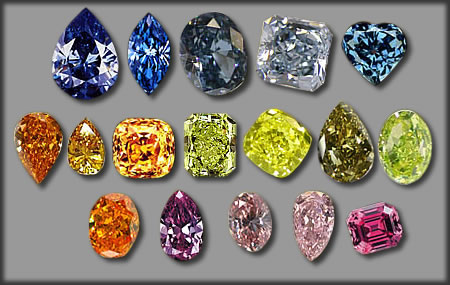
Though diamonds are prized for their lack of color, no diamond is totally colorless and they can occur in a wide range of colors, from black to fancy colored diamonds, red being the most rare. Diamonds that are certified as "red" are so rare that most diamond dealers have never seen one and they generally are not available in the market.
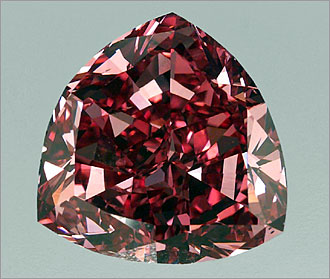 |
| World's largest cut fancy red, the 5.11 carat Moussaieff Red, cut in the mid-1990's from a 13.90 carat rough stone. Image via The World of Famous Diamonds. Sold in 2001-2002 for an undisclosed amount. |
Pink diamonds, also rare, are highly sought after and for the most part, in the market, are the most expensive as they are closely associated with red diamonds. Blue is the next rarest color and are almost exclusively mined in Australia and South Africa. There are even green (caused by radiation exposure), purple, and orange diamonds.
 |
| Image via Jack Hood Jewelers Online |
When buying fancy colored diamonds, if authenticity is important to you, always check the certificate to make sure that it has been certified as natural. As with so many other gems, diamonds are often treated to enhance or change their color.
I will not go into all of factors involved in grading and valuing diamonds because it's so complex, other than to say cut, color, clarity, carat. I personally don't hold much to the advertising campaign that dictates six months of salary to buy an engagement ring. I feel that it is better to buy a smaller good quality diamond than a larger, lesser quality diamond, inspite of my love for drop dead bling. However, when the girls are standing around comparing rings, some may feel the sting of having the smallest diamond. Buying diamonds is a personal choice based in part of how you feel about carats: quality or quantity. Lucky is the girl who can get both.
Neither am I going to discuss whether or not diamonds are rare or if the price is artificially jacked up by the DeBeers Corporation. No and yes.
Some interesting tidbits about diamonds:
- Did you know that diamonds will burn? Think about it- they're made of carbon and carbon burns. There are stories around of diamond cutters "in the olden days" who had diamonds flash or explode while they were being cut. A rare occurrence, this rarely happens now with modern cutting tools and techniques. Check out this video but don't try it at home.
Gray Matter: Burning Diamonds from PopSci.com on Vimeo
- Diamonds are very old. Most diamonds are close to 1 billion years old.
- Some diamonds, about 10 percent, will fluoresce a lovely blue under UV light such as sunlight or a black light. All diamonds will fluoresce under x-ray, which is actually used in mining to separate from non-diamond bits. Fluorescence is a hotly debated topic in the diamond industry but the Gemological Institute of America finds that it had no negative impact on a diamonds appearance. Yet the debate rages on. Don't let the presence of fluorescence impact your buying. Buy what you like. If a diamond is offered for less money due to fluorescene- BONUS!
 |
| Image via Gemological Institute of America |
- You can crush a diamond with a hammer.
- The engagement diamond is worn on the third finger of the left hand, because the ancient Egyptians believed that the vein in that finger ran directly to the heart.
- The word 'carat' comes from the carob tree whose seed was used for centuries as the standard for weighing precious stones.
- Want to check his sincerity? If you place a diamond in a glass of water you will be able to see it clearly. A glass "diamond"- nope. Gosh, I hope you can see it.
- Only twenty percent of all diamonds mined are used for jewelry. The rest are either used for industrial purposes or simply discarded as being too inferior for any use. That's a weird idea, isn't it?
So I'll be quiet a minute and we can just look.
 |
| Image via Wikimedia Commons Macro photo of an industrial cutting blade with tiny diamonds embedded in the metal. |
 |
| 17th century necklace, Carnegie Museum I've seen this- it's gorgeous. |
 |
| Kimberlite diamonds. Image by Liza Mueller via Picassa. |
 |
| Antique (1895) 18kt gold brooch with 1.10 carats of diamonds. $3,000- still available girls. Via Aunt Judy's Antique's |
 |
| This 24.78 carat flawless beauty sold for a record $46.16 million at Sotheby's last November. Image via Jewelry Insider |
 |
| Image via Reverb |
Oops- how did he get in here?
 |
| Image via The Diamond Broker |
But as beautiful as diamonds are, they somehow inspire the truly stupid and ridiculous, as if the presence of diamonds makes you or some object classy. And if a few diamonds are good then an overabundance must make for some real high-class action, right?
 |
| Image via The Edje |
The Hot Wheels car, cast in 18kt gold and encrusted with 23 carats of diamonds, valued at $140,000 not stupid enough for you? How about Damien Hurst's diamond encrusted skull?
 |
| Image via DailyMailOnline |
Covered with 8,601 diamonds, the skull is a platinum cast of a skull Hurst (or Hirst) bought at a taxidermy shop, thought to belong to a 35-year old man who lived in the 18th century. The original teeth were polished and set in the cast skull.
Still not ridiculous enough? Oh girls, let's shopping....
 |
| Diamond encrusted iPhone, valued at $177,300. Image via Blavish |
 |
| Kanye West's teeth. Image via Celebrity Rush. |
 |
| Hello Kitty ring- $4,250. Sold out- scary thought. Image via PopGadget |
 |
| $17,000- actual use not recommended. Image via BabyGadget. |
OK, this ridiculousness could go on all day.
As gorgeous and intriguing as diamonds may be, it would be irresponsible not to include a very controversial aspect of the diamond industry in this post. Conflict diamonds. Let me quote from GlobalWitness.org:
- Conflict diamonds – also known as blood diamonds – are diamonds that are used to fuel violent conflict and human rights abuses. They have funded brutal conflicts in Liberia, Sierra Leone, Angola, Democratic Republic of Congo and Côte d’Ivoire that have resulted in the death and displacement of millions of people. Diamonds have also been used by terrorist groups such as al-Qaeda to finance their activities and for money-laundering purposes.
Conflict diamonds came to the world's attention in the 1990's out of the brutal civil war in Sierra Leone, though that country has not been alone. The civil war in Sierra Leone soon became about controlling the country's diamond business. It has been suggested that conflict diamonds, at the bloodiest height of their use in funding war, accounted for 4% of the diamond trade. Some agree, others say it was closer to 15%, some feel the numbers have been vastly over-estimated, but even 4% represents an astounding financial incentive. And, given the heart-breaking brutality employed against virtual slaves in the mining pits, 4% is still too high a figure. This has been a consumer-funded crisis.
 |
| Image via UN.org |
That brutality, murder, rape, and terror have been used in the mines of Africa is undeniable. It makes the absurdity of Kanye's teeth and the Hot Wheels car downright sickening.
As outrage over conflict diamonds increased, especially after the release of the movie Blood Diamonds, brokers began to realize that the issue of conflict diamonds was harming their industry. Pressured by international agencies, NGO's, and foreign governments, change began to slowly chip away at the diamond industry. The Kimberly Process Certification Scheme was established in 2003 by leading diamond producing nations in Africa to stop the trade of diamonds that fund conflict. "The scheme requires governments to certify that shipments of rough diamonds are conflict-free and put in place effective controls to prevent conflict stones from entering the supply chain. Participant countries must enact domestic legislation to implement the scheme, and can only trade rough diamonds with other members. This creates a strong incentive for countries that want to produce, trade or process uncut stones to join. As of 2010, there are 75 governments participating in the KP." (reference)

Has progress been made? Many sources will say that conflict diamonds now account for 1% or less of the international diamond trade. It would be impossible and irresponsible for me to tell you whether or not that number is correct. Progress has been made but because this is a human activity there will always be greed, corruption and flaws. Illegal trade in back allies continues with no pretense that the diamonds will ever leave their country of origin. Smuggling, lax diligence, greed and apathy continue. Also, there are only 75 signatories with the Kimberly Process, so that leaves many nations out of the conflict-free loop.
 |
| Image via UN.org |
It has been difficult for me to know how to proceed with this aspect of a post on diamonds. There's no denying that April's birthstone remains beautiful, regardless of where or how it is mined. I hoped to give you facts, not hype, and every side of this issue has both and neither. It's hard to sort it all out. I have read countless articles, visited website after website, and watched some of the most heart-wrenching and terrifying video I've ever seen. As I write this, I am trying not to cry. Again. It would be so much easier to close my mind against the reality of conflict diamonds.
So what can we do? First and foremost, if you must have a diamond, insist with your jeweler, face-to-face, that he verify his gems as conflict-free. If he cannot, go elsewhere. Can a retailer really be the one to verify diamonds as conflict free? No, the sad truth is that from the first time a rough diamond is traded it becomes increasingly difficult to verify its source. By the time it is polished, it is virtually impossible to identify where it came from. But pressure at the consumer level for certified conflict-free diamonds increases pressure higher up the food-chain. If conflict diamonds have been a consumer funded crisis, then the solution must also be consumer funded.
| Image via Reuters |
Educate your self. Amnesty International's website has loads of information. Also check out DiamondFacts.org, GlobalWitness.org, and the KimberlyProcess.com.I personally don't think it's effective to simply refuse to buy diamonds. There are plenty of folks willing to buy a diamond without much thought to its source. If you want diamonds, go buy diamonds. There is no shame in buying diamonds even if you are aware of blood diamonds. But be an educated shopper, let your jeweler know that you are willing to purchase certified conflict-free diamonds only. And stick to it, no matter how sweet the bling he dangles in front of you. When your friends admire your sparkly new diamond, don't forget to tell them that you made sure you bought only a certified conflict-free diamond and why. I'm not taking this stance because I hope to ease my mind should I want to go buy a diamond. Millions of individuals depend, in one way or another, on the diamond industry for their livelihood, to put food on the table each night. That includes the men, women, and children (yes, children) working in the diamond mines. Shutting down the diamond industry does them no good. Your voice is important but your actions must speak louder than your words. It is important to support the efforts of the Kimberly Process, the UN, the World Diamond Council, and countless other organizations, no matter how flawed and imperfect they may be. Insist on certified conflict-free diamonds only. There is simply no room for blood in your jewelry box.
 |
| Late 1800- early 1900's, French. Image via Collector's Quest |