Monday, February 7, 2011

If A Dog Were Your Teacher


If a dog were your teacher, you would learn stuff like:

When loved ones come home, always run to greet them.


Sampson runs to greet me
by carolvinzant via Flickr

Never pass up the opportunity to go for a joyride.

arf!  can i drive in the parade too??  (tx independence day #4)
by jmtimages via Flickr


Allow the experience of fresh air and the wind in your face to be pure ecstasy.

When it’s in your best interest, practice obedience.

Let others know when they’ve invaded your territory.

Army Dog Handler and Dog at Work in Camp Bastion, Afghanistan
by Defence Images via Flickr


Take naps ...


...and stretch before rising.

You gotta stretch it all!
by Seoulful Adventures via Flickr


Run, romp, and play daily.

Light fast dog...
by MrSHIZ via Flickr


Avoid biting when a simple growl will do.

On warm days, stop to lie on your back on the grass.

On hot days, drink lots of water and lie under a shady tree.

Dog in pool
by MrSHIZ via Flickr


When you’re happy, dance around and wag your entire body.

Always happy...
by buzzsnap via Flickr


No matter how often you’re scolded, don’t buy into the guilt thing and pout…

... run right back and make friends.

Delight in the simple joy of a long walk.

The Boys Waiting
by Yellow Snow Photography via Flickr


Eat with gusto and enthusiasm.

Stop when you have had enough.

Dogs Life II
by ManWithAToyCamera via Flickr


Be loyal.


Never pretend to be something you’re not.
Boxer Ballerina
by Matt Stratton via Flickr


 If what you want lies buried, dig until you find it.

Digging Dog
by rumpleproofskin via Flickr


And MOST of all…

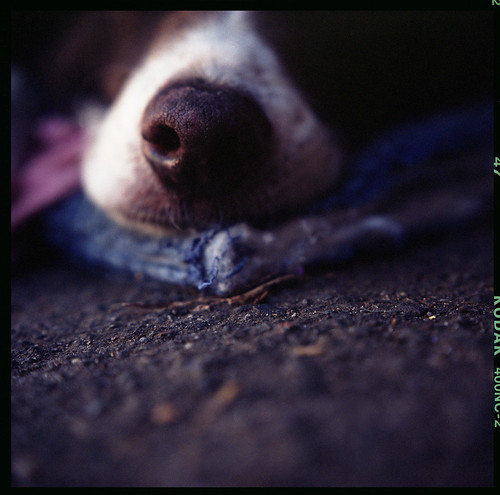
When someone is having a bad day, be silent, sit close by

and nuzzle them gently.

by ktshawx via Flickr
 Author Unknown


Wednesday, February 2, 2011

February Bling- It's Amethyst!


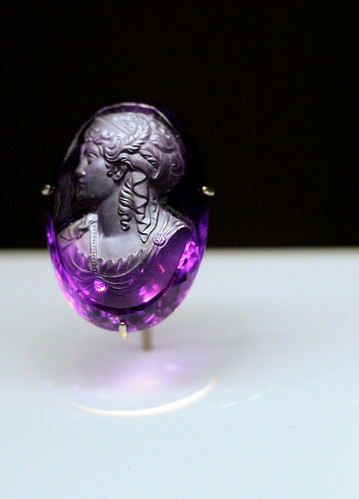
amethyst cameo (Brazil)
by opacity via Flickr

Oh my.... how gorgeous can you get?


The Amethyst was adopted as the official birthstone of February in 1912 by the American National Association of Jewelers. It is may also be given for the 4th, 6th, and 17th wedding anniversary.

If you need an excuse.


Amethyst is quartz. We learned last month that January's garnet can be found in a wide and surprising variety of colors. Amethyst, to be an amethyst, must be purple. Manganese is what makes quartz purple and iron is what determines the depth of color in an amethyst.


But oh the colors.

Amethysts range from light lilac to lavender to mauve to deep purple.


  The ideal amethyst is a clear deeply intense purple.


The most valuable amethyst, however, are a medium purple with flashes of rosy-red.

Most amethyst on the market today have been heat-treated for color enhancement.


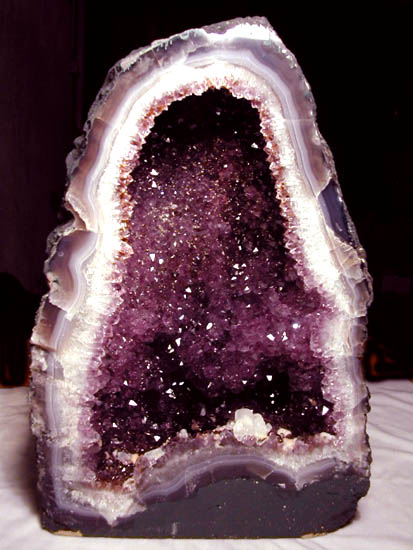
Amethyst occur as geodes, as a crust over the host rock (druzy), or as six-sided crystals. But they must be purple. "Green  amethyst" are irradiated or otherwise heat-treated pale amethysts and are not rare. Or valuable.

Though they can be found almost world-wide, the finest amethysts have traditionally be found in Russia. Today, Brazil  and Zambia are primary sources for the February's bling.


via Kornbluth Photography, circa 1400 AD  

Amethyst gets its name from the Greek word "amethysots" meaning "not drunk" and was thought to protect from intoxication or poisoning by either wearing it or drinking from an amethyst cup.


Bernardine.com tells us this legend:

According to legend, amethyst originated when Bacchus, the God of Wine, grew angry at mortals. He vowed the next mortal that crossed his path would be eaten by tigers. At that time, a beautiful young maiden named Amethyst was on her way to worship the Goddess Diana. Diana, knowing of Bacchus vow, turned Amethyst into a pillar of colorless quartz to protect her from the tigers. Bacchus, witnessing the miracle, repented and poured wine over Amethyst, staining her purple.


Amethyst was also thought to protect a warrior in battle and to promote healing. It was also thought to keep its wearer cool-headed and quick-witted, two things you might be anyway if you were not intoxicated. And of course, amethyst was been associated with royalty as far back as 2,500 B.C.

OK, let's stop talking and just look for a minute.


Yes, it's a bathtub. This beauty will put you back $121,200 US and a matching tumbler, lotion dispenser, and soap dish are available. For that next Make-over Monday.


And, least we forget that it's a jungle out there, here is a butterfly to surprise and delight us.
via StyleGuru.com

Which reminds me that I didn't have a garnet butterfly for January's bling, so ...


via Collectible-Articles.com

OK, good, we're all caught up. And hey-- 

Happy Birthday all of you February babies.

Saturday, January 29, 2011

Our Elusive Barn Owl

If this is your image, please let me know immediately so I can credit you. It's awesome.


I saw it! I finally saw it!

via National Wildlife Federation

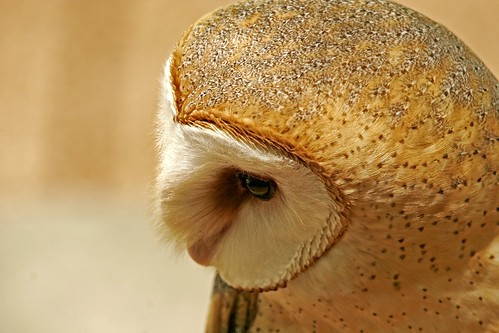
And just in time for Valentine's Day, with it's beautiful heart-shaped face.


Barn Owl
by Brian Scott via Flickr

I have been hearing this gorgeous bird's eerie shriek off and on since before Christmas, usually in the pre-dawn hours when I first awake, about 4:30am.


(Make sure your volume is not up too loud)


I know, freaky, right? Now you know why it caught my attention.


via Barn Owl Trust

I thought it was an owl of some sort so I visited The Owl Pages to learn more about my freaky mysterious midnight shrieker. You can go to their page specifically about barn owls by clicking here.


via Major Wildlife Photography
 The only other time I've seen a barn owl was several years ago when my husband and I were driving home one evening from his parent's farm. Our headlights flashed over this huge magnificent creature perched just off the road and we both looked at each other to check our sanity. "Did you see that?" we asked at the same time.


by Annie Marie Mussleman via pcnw.org

This morning I was up at my usual 4:30am but didn't hear our bird until just as they sky was getting light. He was shrieking down at the edge of the yard so I very carefully stepped out onto the porch. Barn owls have incredible hearing and locate their prey more by sound than sight so I knew extreme quiet was necessary. I heard him shriek a couple more times and then, just as I turned my head in his direction, he came flying up the hill, maybe 4 feet off the ground, across the yard, and over into the field. Thrilling hardly describes it.


Diffrent Point of View
by Picture Taker 2 via Flickr

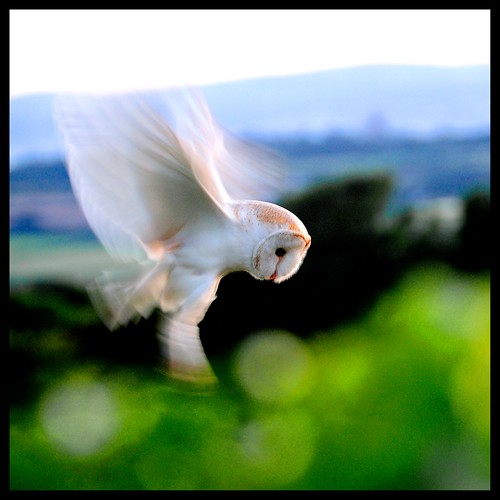
Not a sound. He flapped his (upwards of 43") wings a couple of times but still, not a sound. I've learned that barn owls fly so silently because their wings do not have oils and because they rely so heavily on their hearing to locate prey, the flapping sound of their wings does not interfere with their hunting. Pretty cool, huh?


Movement
by midlander1231 via Flickr

Though barn owls are fairly wide spread, being found on every continent except for Antarctica, they are not overly common in our area. We live on the edge of one of those mysterious blank spots on their range map. Neither do they tend to migrate. However, they are vulnerable to extremely cold winters, which we have been experiencing in our neck of the woods. I would guess that our barn owl is on the move hoping to find a bit warm weather. It's a theory and maybe if one of you knows better I would love for you to share with us.

Random Oldies - Barn Owl
by me'nthedogs via Flickr

I have another owl story to share with you sometime but I hope you've enjoyed a peak at our barn owl today. He's a big magestic creature and I hope he stays around.

See ya next time.

Monday, January 24, 2011

Tortellini Spinach Casserole- Mmmm


OK- I'll just let you think that this is the sensibly sized serving of Tortellini Spinach Casserole that I usually eat. Oh baby is this casserole a little slice (or big helping) of heaven.

No, I do not remember where I originally got this recipe but a quick Internet search brought me to Taste of Home and the exact same recipe. So we'll give them the credit and you can click here to go check it out. I haven't changed the ingredients any but I do work the process just a bit differently to cut out one of the bowls that would otherwise need to be washed.

You will need:


2 10-ounce bags of frozen cheese tortellini
1 pound of fresh mushrooms
1 tsp garlic powder
1/4 tsp onion powder
1/4 tsp black pepper
1/2 cup butter, divided
1 12-ounce can evaporated milk
1 8-ounce block of brick cheese, cubed
3 10-ounce packages frozen, chopped spinach, thawed, drained, and squeezed dry
2 cups (8 ounces) part-skim mozzarella cheese shredded

OK- let me make a comment. I have in the past, and actually prefer, to use a couple cloves of garlic (minced or chopped) and some finely chopped onion (1/4 cup-ish) in place of the powder stuff. If you do this add some salt to taste.


Preheat the oven to 350 degrees F.


Cook the tortellini and drain it well. You can leave it in the colander.


While the tortellini is cooking, slice up your 'shroomies ...


... and saute them in a very large pan with the garlic, onion and pepper in half of the butter. When they are soft, remove from the heat to a bowl.


In the pan you used to saute the 'shrooms...


... combine the milk and remaining butter. Bring to a gentle boil; stir in the cheese. Cook and stir until it is smooth. Mmmm, creamy.


Add the mushroom mixture, the tortellini, and the spinach. It is helpful to make sure you have pulled apart the spinach after you have squeezed the daylights out of it so that it isn't a big ball of spinach and will stir up easier.


Transfer everything to a greased 3-quart baking dish and top with the mozzarella.

Cover and bake for 15 minutes then bake uncovered for another 10-15 minutes or so until your casserole is all warm and bubbly.


Mmm - cheesy and full of pasta and iron.


Mmm. I can't help it-- mmm.

Enjoy!


Thursday, January 20, 2011

Colonel Mustard On The Chest With A Poultice

My husband has been is heaven the past couple of days. I've been a coughing maniac and have lost 100% of my voice. I mean absolutely 100% - not one croak left in my throat. It just doesn't have the same effect to stand there mouthing up a storm with only an occasional squeal to get Big Un's attention. Takes the joy right out of a good nagging. Kidding, I try not to do that though I suppose some nagginess slips out by accident at times. I have noticed, funny enough, that everyone I talk to starts to whisper.


Three days of cough syrup is really just enough. I've had to use the non-drowsy formula, which everyone knows isn't nearly as effective, because, well, it's hard to get anything done when I'm passed out at my desk. And that taste-- it's OK for a day but beginning the second day it's just sickening.

Солволан // Solvolan
by kaladan via Flickr


So today, since I'm home alone, I whipped up a good old-fashioned mustard poultice. My hubby's grandmother swore by them and was so happy when I first tried one out.


You need two basic ingredients (plus a little water):
Mustard and flour


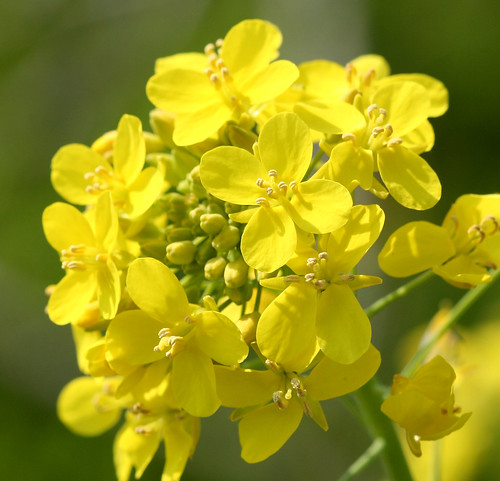
Mustard, of course, is the active ingredient and has been used for centuries as a spice but also as a medicine. References to mustard have been found as far back as 5,000 BC. It's healing uses include not just for cough, chest congestion, bronchitis, and other respiratory troubles but also in treating asthma, snake and scorpion bites, lowering blood pressure, relieving sleep distrubances in menopausal women, and in the treatment of arthitis, rheumatism, and muscle soreness. At one time, surgeons used a mustard paste to disinfect their hands. It also has anti-fungal properties and works to cure athlete's foot. It was even thought, at one time, to be an aphrodisiac and was used in love potions.


Mustard Flowers
by philipbouchard via Flickr


Not bad for a weedy little flower.


What we will make to day is technically a mustard plaster since it will be wrapped up in cloth. A poultice is a concoction that you mix up and spread directly on the skin.


But you have to be careful with mustard because part of it's appeal, besides that sinus-clearing rush you get when you add too much to your food, is that it heats up and can cause blisters. So I go with the wrap and call it a poultice because that's what Great-Grandma called it.


There are scads of recipes and formulas for mustard poultice. Here's mine, based upon a little experience and an unpleasant Poultice Fail.


For a single batch to use on my chest for chesty ailments, I use:

2 tablespoons of flour
1 teaspoon of dry yellow mustard


I know, not much mustard but hang in there with me- it works.

Yellow mustard is the mildest type of mustard, then brown, then black, the preferred mustard for a poultice. I've never seen dry brown mustard (maybe never looked) and have never seen black mustard in any form. I know it's out there but since yellow mustard will do, let's go with it.


The flour is basically a carrier for the mustard- it doesn't actually do anything. Maybe tones down the mustard because straight mustard might just burn through to your sternum, now that I think about it.

You don't have to use flour. Oatmeal, bread, starch, even mud, will all work.


I add 3 to 4 teaspoons of warm water, just until it makes a nice paste. You'll start to smell it as you mix. Mild but present.


You'll need something to wrap the poultice plaster. An old bandana works well as would a piece of light-weight flannel. Wet a corner of the bandana with some fairly warm water...


... and spread your mustard paste out in a nice even layer on the wet fabric.


Fold the bottom of dry cloth up over the paste, then the right side over it again to make a square, then fold the bottom up one more time. This makes a nice manageable size and the extra layers of dry cloth will help keep the heat in.


Find a nice comfy chair to lean back in for the next 30 minutes. Place the wet side of your little bundle face down on your chest (you want the wet side touching your skin).


I usually put a wash cloth between the bandana and my clothes to keep my clothes from getting wet and to keep more heat in the bandana.


Within 10 minutes you'll begin to feel warmth as well as to smell the mustard, which clears your sinuses nicely. Take the poulice off if it begins to get uncomfortable and don't leave it on for more than 30 minutes. If you think you'll fall asleep or might get caught up in a good book, set a timer. Thirty minutes.


This is how my chest looked today after 30 minutes- warm and red. Sorry about the boobage. The redness will start to fade immediately.

Now, let me tell you about my Poultice Fail. The first time I made a poultice, after consulting with my husband who has fond memories of his grandmother slapping one on him when he was a kid, I left it on too long. Like for well over an hour. I was skeptical because what's one teaspoon of mustard going to hurt and it was just another thing Grandma talked me in to trying.  Unfortunately, I had a healthy blister on my chest for over a week.

SO...

Do not use a mustard poultice on children, the frail elderly or anyone in a seriously debillitated state.


So I'm glad Great-Grandma talked me into trying a mustard poulitce. She knew I was good for an experiment. Once she and I tried eating a weed known in these parts as "Red Root" (maybe you call it pig weed) because one of her Korean friends told her they ate it as a vegetable when she was growing up.


Great Grandma was a frugal gal, even when it wasn't hip to be frugal, and having brought up a family during the depression she knew what it meant to waste not want not. The thought that she had been pulling Red Root from her garden all of those years and throwing it away when it was something you could eat almost had her in tears. So we tried it.


The best part about steamed Red Root with soy sauce is the soy sauce. But we had a good giggle over it anyway. What a great gal, my hubby's grandma. She never did get me to eat ground hog, though.


So that's it for Mustard Poultice. You should try it out and remember to drink plenty of fluids and get some sleep. It's that time of year.

Stay well.


Saturday, January 15, 2011

Oh Look- A Strandbeest

I have decided that Engineers are really cool people. Dream it up, figure it out, and make it- even if it's outrageous. When you throw in a good helping of creativity and a wild imagination, iced with the sweet frosting of passion, well, you get Theo Jansen...


Theo Jansen and a Strandbeest
by JulianBleecker via Flickr


... and his Strandbeests.


Animaris Umerus - Part 2 from Alexander Schlichter on Vimeo.


Must. Watch. Video.


The skeletons of these animals, as Mr. Jansen considers them, are made of plastic pipe and tubing. They are wind-powered and are even able to store wind-energy in the plastic bottles you see along their spine. When the pressure, which is built up by the fins, or feathers, reaches that magical number, it is released from the bottles and pumped out into the "body" of the beast and generates movement. Well, that's my simplistic understanding of it anyway.


by JustinShull.net


via treehugger.com


You want one, don't you? We want one! Hop over to Instructables by clicking here where you can find directions to build a small motor-powered K'nex.


OK, that's it today- just wanted to share this with you.
Now my kid and I are off to gather the parts.

Have a great Saturday!